Saturday, January 8, 2022

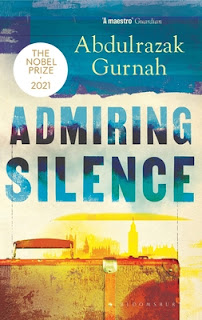
the last book I ever read (Admiring Silence by Abdulrazak Gurnah, excerpt twelve)

from Admiring Silence by Abdulrazak Gurnah, the 2021 winner of the Nobel Prize for Literature:

There was more frenzy on the plane itself, with arguments over seats and luggage space. The boarding cards showed every passenger’s seat reservation, so it could only be a habituated fear of being short-changed and screwed by officials that prompted the anxiety, though perhaps some of the more obstinate contestants were in it just for the love of hassle. The staff of the Kenya Airways flight kept well out of it for a while, then moved in with ruthless courtesy and managed to get everyone seated in a little less than half an hour. I found myself in a middle seat with a beautiful Indian woman on the window side of me and a plump man in his sixties (I’d guess) in the aisle seat. When I sat down next to the man, he gave me a long, unwelcoming stare, and punished me throughout the flight by releasing a series of foul-smelling farts. After a while I could see them coming. He would make a small shuffling movement, and that would be the signal that something was on the way. It seemed that every small adjustment he made to his body released poisonous fumes. As you may imagine, life became ever harder after he had had his airline meal. I learnt to respect that man’s quiet assurance over the next seven hours.


Friday, January 7, 2022

the last book I ever read (Admiring Silence by Abdulrazak Gurnah, excerpt eleven)

from Admiring Silence by Abdulrazak Gurnah, the 2021 winner of the Nobel Prize for Literature:

It was in this casual way that I was invited to put the noose around Safiya’s neck and drag her into the shambles of my life. In reality, my mother’s question was forcing the matter to a crisis, my crisis, not the resolution she thought she was bringing about by firm insistence. No escape. My audience waited: Rukiya, Akbar, my mother. Should we not fetch my stepfather? Should he not be here at the execution, to hear me ask forgiveness before submission? They waited, words of approbation lying coiled alongside sour words of blame.

I gathered myself and give it to them, relishing the impact that I knew I was going to make. Here it is, this is how it really is, a lot worse than you could have imagined and nothing much can be done about it.


Thursday, January 6, 2022

the last book I ever read (Admiring Silence by Abdulrazak Gurnah, excerpt ten)

from Admiring Silence by Abdulrazak Gurnah, the 2021 winner of the Nobel Prize for Literature:

‘What is it that the project will translate?’ I asked. ‘You still haven’t told me about the details yet.’

‘The great books of the world,’ he said, I think with some relief and certainly not with a triumphant bark of appropriation, but in a voice of mildly beseeching modesty. ‘We want to make the profound thoughts they contain available to ordinary people. Of course, the project will work out its own priorities but I would’ve though it would probably want to begin with Shakespeare, Marx, Tolstoy and Hemingway. As perhaps you know, the Rais of our Federal Republic is very fond of Hemingway, and he is himself a translator of Shakespeare. Marx we need so that people can have a firmer understanding of the democractic socialism which is the governing ethos of our state, and Tolstoy for his sympathy with the peasants and the masses.’


Wednesday, January 5, 2022

the last book I ever read (Admiring Silence by Abdulrazak Gurnah, excerpt nine)

from Admiring Silence by Abdulrazak Gurnah, the 2021 winner of the Nobel Prize for Literature:

When the war came it was possible to do a different kind of business. (He grinned at this point, and although he did not say so, I knew from somewhere I can no longer remember that in the early Forties he had spent a month in prison for smuggling.) Everything was short and rationed, the British needed it for their own people, who were far more important than us. So whatever you could find – rice, sugar, simsim, millet – even if it was of poor quality, there was always a good market for it. Peeple learnt to eat jaggery and brown rice and shellfish when before they would have spurned such food as fit only for servants and heathens.

It was difficult to get news of the war. There were no radios then, or very few, and those who owned radios kept quiet about it because they were afraid they would be confiscated. The British were nervous about everything, so we guessed that things were not going well for them. It was not a surprise. We knew the Germans and how they made war. Some of the riff-raff here joined up, and some young people who were still at school did so too, because they were promised that they would be sent to a big college when they returned, and would all become doctors and lawyers. It’s a good thing you didn’t become a lawyer, their business is to cheat. Or a policeman, because if you are a policeman and they order you to arrest your mother you have no choice but to obey, and God has said Honour your father and your mother after Me. So if you become a policeman, you are also saying that you are prepared to disobey God if the need arises. Anyway, they were sent to Abyssinia to fight the Italians and to Burma to fight the Japanese, and we didn’t see them again until the end of the war, those who came back. The ones who had joined up from school asked about their big college, and they were sent to the teachers’ college in Beit-el-Ras, and others became policemen after all.


Tuesday, January 4, 2022

the last book I ever read (Admiring Silence by Abdulrazak Gurnah, excerpt eight)

from Admiring Silence by Abdulrazak Gurnah, the 2021 winner of the Nobel Prize for Literature:

I didn’t act like a boy-victim-hero out of a Dickens novel, not that bad. But I could have done better. I could have been resourceful, charming, brave. I wasn’t brave, I could have done better. Perhaps that was why my stepfather left me to myself. I had the opportunity, the connection, the forbearance of circumstances, the contacts (his), and I chose to act like a stepson. Nor do I remember that time tragically. There were stories, in the first place, stories to fill the hours and the mind in the contest with life, to lift the ordinary into metaphor, to make it seem that the time of my passing was a choice in my hands, that there was method in the manner of my coming and my going. This is what stories can do, they can push the feeble disorders we live with out of sight.


Monday, January 3, 2022

the last book I ever read (Admiring Silence by Abdulrazak Gurnah, excerpt seven)

from Admiring Silence by Abdulrazak Gurnah, the 2021 winner of the Nobel Prize for Literature:

As we were waiting to disembark, my companion was back at work with his towel, smiling at my nervousness and wishing me luck with benignly mailicious glee. The heat and smell of the earth struck me as if for the first time. I didn’t remember it like that, not the humid fumes of decomposing vegetation and baking earth which made me heave for breath. The terminal building was new, squat and anonymous, all glass and steel, with a viewing balcony on the first floor. Some way to the right was the old building, looking small and decorative with its crenellations and red-tiled roof and heavy wooden railings, like a pavilion in an ornamental garden or a villa on a Mediterranean hillside. As we walked across the tarmac I felt as exposed as if I had stepped off the plane naked, or as if my clothes were too baggy or too tight, or too colourful and ridiculous, as if I were a refugee from a circus. I looked out for familiar faces on the balcony, and I saw one that seemed as if it could be my stepfather. After such a long time, and from such a distance, I could not be sure, so I waved to be on the safe side. The man I had waved to stared for a moment and looked behind him, then turned back towards me with a look of surprise. He was too young to be my stepfather, I could see that now.


Sunday, January 2, 2022

the last book I ever read (Admiring Silence by Abdulrazak Gurnah, excerpt six)

from Admiring Silence by Abdulrazak Gurnah, the 2021 winner of the Nobel Prize for Literature:

‘I went to see the doctor this morning,’ I told her when she came back, pausing briefly to get a decent bit of tension going. ‘He told me my heart was buggered.’

She stood very still for a moment, waiting. ‘What do you mean, buggered?’

‘That’s what the doctor said. Perhaps we should look it up in a medical dictionary. I just assumed he meant it was defective in some important way.’

“But didn’t he say what was wrong?’ she asked, looking quite distraught. That was nice.